
The 2022 ECOSOC Partnership Forum was be held on 2 February 2022 on the “Building back better from the coronavirus disease (COVID-19) while advancing the full implementation of the 2030 Agenda for Sustainable Development”. Multiple actors and stakeholders participated, including countries, the United Nations system, including international financial institutions, as well as international organizations, parliamentarians, local governments, non-governmental organizations, the private sector, civil society, scientists, academia, women, youth and others.
Participants debated solutions and policies to overcome the COVID-19 pandemic guided by the SDGs. They were expected to (a) exchange new ideas, expectations and priorities which should be explored further by the Council and the high-level political forum in the following months; and (b) shine the spotlight on forward-looking actions and partnerships by countries and all relevant stakeholders that can help recover from the pandemic and accelerate progress towards the 2030 Agenda.
Education for all as a key step of the recovery
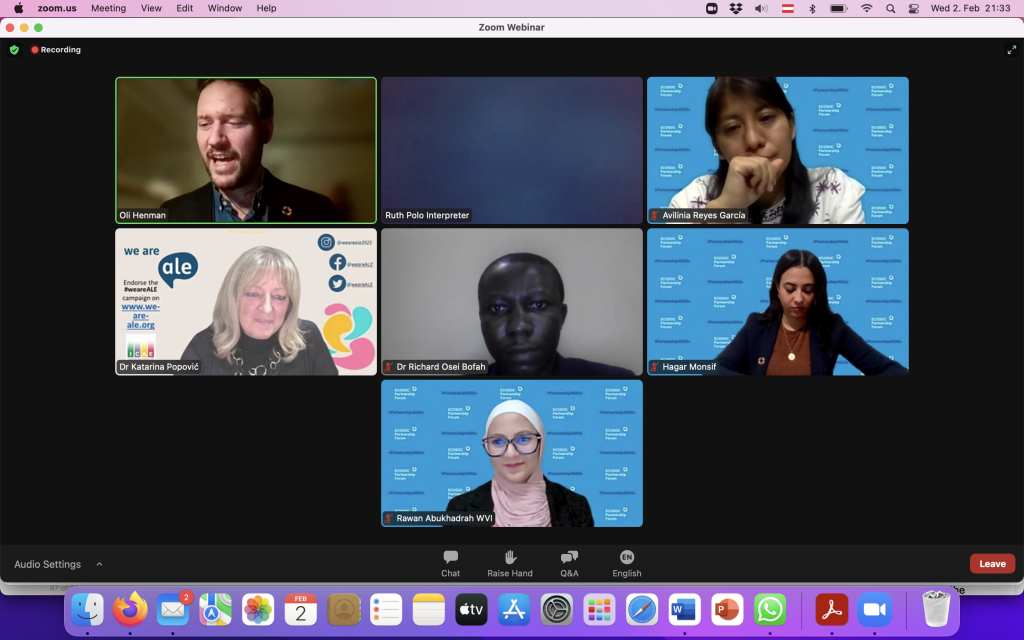
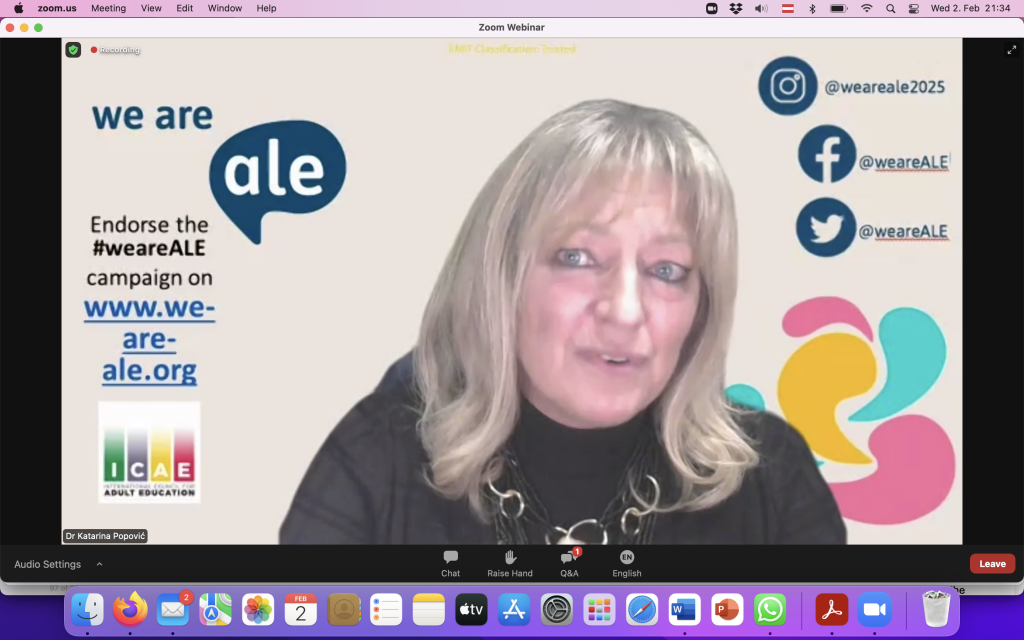
Katarina Popovic spoke on behalf of the Education and Academia Stakeholder Group (EASG) during a spotlight session on Education for all as a key step of the recovery
Background on the event
The COVID-19 pandemic has created the most severe disruption to global education in history, affecting nearly 1.6 billion learners in more than 190 countries and all continents. Closures of schools and other learning spaces have impacted 94 per cent of the world’s student population, up to 99 per cent in low and lower-middle income countries. At the same time, education has moved into the “virtual world”, using digital and ICT tools to bridge the gaps in learning. But the prolonged pandemic has raised further and more serious issues, such as the ‘digital divide’, disruption of the provision of essential services to children and communities, reduction in access to nutritious food, challenges for many parents to work, and an increase in the risk of violence against women and girls.
The session provided diverse perspectives on the current challenges facing the education system in light of the COVID-19 pandemic; as well as good practices on the engagement of stakeholders and resilient models for providing quality free education for all to achieve the Sustainable Development Goals.
Key Issues discussed
- The impact of the COVID-19 pandemic on education infrastructure and the major challenges faced across the globe to provide free quality education for all
The specific case study of Ghana was shared and the steps that have been taken by the Government of Ghana to provide targeted support to ensure that education continues to be accessible for all, including support for online learning and also a package of economic support to families facing a loss of earning to ensure continued education.
- The particular challenges for access to education faced by marginalised communities were highlighted
A number of challenges in terms of access to education were considered including the perspective of young indigenous people in Central America and those in refugee situations in and around Syria.
In the case of indigenous communities, a clear emphasis was placed on the importance of valuing traditional knowledge and ensuring learning that builds on ancestral teachings, that respects biodiversity and the living environment.
In the case of those in refugee situations, the intervention highlighted the need for the integration of Education together with Emergency and Child protection to ensure holistic support for children, contributing to children’s needs to survive, develop and thrive, especially in situations of humanitarian emergencies
- Limitations of online learning
Online learning and virtual platforms have helped us to bridge the gaps in education and learning during the COVID-19 pandemic, and they will play an important role in the future as well. But concerns were raised on the push to move most education, especially lifelong learning onto the online spaces and virtual world.
It is offered as a ready-made solution for future education. However, there are a number of challenges:
- Half of the world is still not online! We will not be able in one or two years of recovery to equip everyone with relevant digital skills;
- There are areas of learning and education that cannot be fully covered through online formats, for example: education for empowerment, education for peace and tolerance; critical thinking, open-mindedness, creativity; increasing motivation for lifelong learning; social-emotional learning; education for health, sport and recreation; developing skills (especially in vocational training) that require practicing and exercising;
- It is not a suitable method of learning for some learners‘ groups and some contexts;
- It is still more important ‘what’ (goal, content) we learn than ‘how’ – it is a question of values and ethics. Online learning is an instrument, a powerful means but not the goal. Currently the often quoted “right to connectivity” must not replace the “right to education”.
Key recommendations for action (5 – 6 bullet points)
- The importance of a human rights based approach to education, that recognizes the right to education as a fundamental right.
- The need for sustained long-term support for education as a key stepping stone to ensure we ‘leave no one behind’.
- Specific support and tailored packages should be provided to those who face marginalisation, including a holistic approach to connect child protection and education.
- Respect for diversity and a recognition of traditional knowledge to be incorporated into education curriculums.
- Lifelong learning to be prioritised as a key step for many to re-engage as part of the recovery from the Covid-19 pandemic.
- Donor community and development partners should provide increased and more targeted support for free education available to all.
Read here Katarina Popovic´s session-statement on Lifelong learning in times of COVID-19: education for resilience and transformation
Notes-from-the-session-POPOVICOrganizers: NGO Major Group, African Regional Mechanism for Major Groups & other Stakeholders, Indigenous Peoples Major Group (IPMG), and Education & Academia Stakeholder Group
To prepare for the Partnership Forum, a global online stakeholder consultation has been set up to solicit views, experiences and proposals from all stakeholders and make them widely available in advance of the event. UNDESA has published a summary report to showcase the main findings here.
Further information here: https://sdgs.un.org/events/ecosoc-partnership-forum-2022
